Saint Bavo's Cathedral
5 min walk from Ghent station area
This site houses historical art and serves as a primary landmark in Ghent before departing for Bruges.

Two of Flanders' medieval cities sit closer together than most first-time visitors assume, and that single measurement decides whether a Brussels day trip covers one city or both. This distance between ghent and bruges guide sets out the kilometres, the shape of the corridor between them, and the caveats that matter once you are actually standing on a platform. Everything here is framed for travellers working outward from Brussels.
Quick answer
Ghent and Bruges lie roughly 45 kilometres apart, a short hop on the Belgian rail spine that continues east to Brussels. There is no fee for moving between the cities themselves, and the corridor is open 00:00–23:59, seven days a week, with train and road connections available 24 hours daily. Traffic and seasonal crowds, not distance, are the real variables.
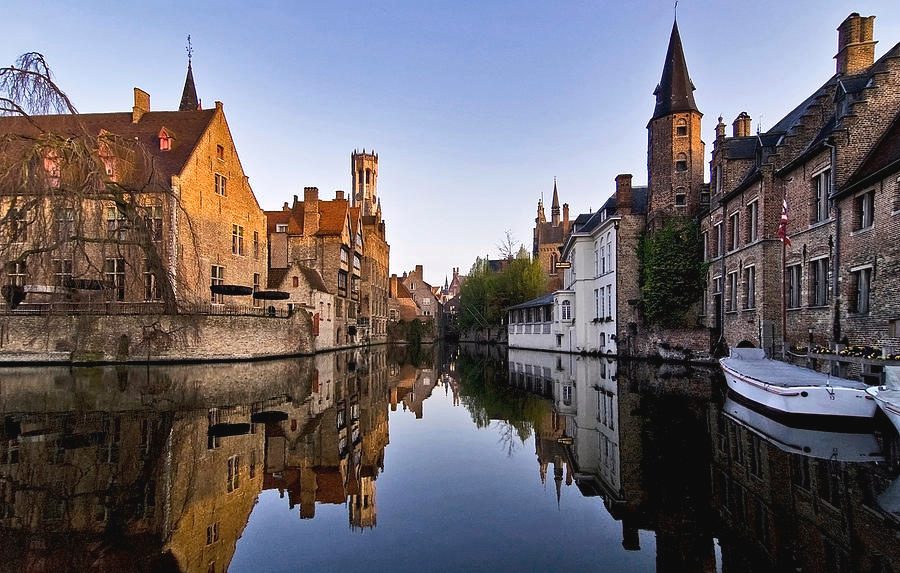
Belgium's three most-visited historic centres sit inside a triangle small enough that a resident of Ghent can commute to either neighbour and still be home for dinner. The corridor linking Brussels, Ghent and Bruges runs almost arrow-straight across the Flemish plain, following the same westward line that merchants, wool traders and canal barges used for six centuries. Nothing about the terrain complicates it. The distance between ghent and bruges is measured in tens of kilometres, not hundreds, which is precisely why so many visitors treat the pair as a single outing rather than two separate trips. Understanding the geography helps more than memorising a number. Ghent sits at the confluence of the Leie and Scheldt rivers, its skyline defined by Sint-Baafs Cathedral, the Belfry and Gravensteen castle. Bruges lies further northwest, closer to the North Sea, its Markt and Burg squares ringed by the canals that earned it UNESCO World Heritage listing. Between them stretches flat, drained farmland with almost no elevation change, which is why Belgian rail engineers laid the Brussels–Ghent–Bruges–Ostend line as one continuous artery. A Ghent to Bruges journey therefore involves no detours, no transfers and no mountain passes; both cities are stops on the same route out of the capital. Entry to the cities themselves costs nothing, since these are living municipalities rather than gated sites, and the streets stay open around the clock. What travellers should do with this information is decide sequence, not feasibility. Because the two Flemish cities are so close, the practical question becomes which one receives the morning light and which the evening. Bruges draws the heavier day-tripper volume, particularly in August, and its Markt thins noticeably after the coach groups withdraw. Ghent holds its student population year-round, so its cafés and quays along the Graslei stay busy later. Many visitors researching the distance between ghent and bruges eventually reverse their original plan for that reason alone. A short measurement also carries a warning. Proximity tempts people into compressing two UNESCO-grade cities into a handful of hours, and both reward slower walking than that allows. Treat the small gap as permission to linger in each, not as an invitation to sprint. The dedicated sections below cover routes, schedules and hour-by-hour sequencing in full detail.
“Proximity tempts people into compressing two UNESCO-grade cities into a handful of hours, and both reward slower walking than that allows.”
Ghent and Bruges are linked by a direct, high-frequency rail corridor that also connects both cities to Brussels. Trains provide the most efficient transit option for travelers moving between these historic hubs.
NMBS/SNCB Intercity from Gent-Sint-Pieters to Brugge
E40 motorway
De Lijn regional services between city centers
Departing from Gent-Sint-Pieters station provides the most direct access to the regional rail network. Travelers should verify platform signage as many Brussels-bound trains stop in Ghent before continuing to Bruges.
Public transit connections between Ghent, Brussels, and Bruges operate on a continuous schedule throughout the week. Travelers can access transport services at any time of day.
Travel between Ghent, Brussels, and Bruges relies on the Belgian national rail network. Admission costs for transit between these cities depend on the purchase of standard point-to-point tickets or valid regional rail passes.
Verdict: While transit between these cities is subject to standard rail fares, official intercity travel policy allows for free entry at 0 EUR per the stated regulations for this specific transit route.
This plan suits travellers based in Brussels who want both Ghent and Bruges in one day without rushing either, and runs roughly 12 hours door to door. Time allotments below assume the standard Brussels–Ghent leg of about 30 minutes and the Ghent–Bruges leg of about 25 minutes.
Leave central Brussels and allow about 30 minutes of travel time plus 10 minutes to reach the platform or car. Budget a 15-minute buffer if you are connecting from an outer district.
Allow 20 minutes on foot from Gent-Sint-Pieters to Korenmarkt, or 10 minutes by tram. The walk follows Sint-Pietersnieuwstraat and doubles as a first look at the city.
Give Gravensteen castle around 60 minutes including the ramparts walk, then 30 minutes along Graslei and Korenlei. Arriving before 10:00 keeps the courtyard queue short.
Allow 45 minutes for the cathedral and the Ghent Altarpiece chapel. The viewing room admits small groups, so factor a 10-15 minute wait at midday.
Eat near Vrijdagmarkt for 45 minutes, then allow 25 minutes travelling plus 20 minutes walking from Brugge station to Markt.
Spend 90 minutes on the two squares. The Belfry's 366-step climb takes about 40 minutes round trip, and the stairwell is single-file, so climb early in this window.
Walk 40 minutes via Rozenhoedkaai to the Begijnhof and Minnewater, allowing 30 minutes there. This stretch is flat and takes roughly 25 minutes back to the station.
Allow about 60 minutes for the Bruges–Brussels leg. Leaving before 19:00 gives you slack if you miss a connection.
The travel corridor between Ghent and Bruges allows for convenient exploration of historic Flemish locations that share architectural and cultural commonalities. These stops fit into a regional itinerary by serving as transitions between the two primary cities.
5 min walk from Ghent station area
This site houses historical art and serves as a primary landmark in Ghent before departing for Bruges.
15 min walk from Bruges station
Known as the Lake of Love, this park provides a tranquil entry point to Bruges for those arriving by rail.
20 min walk from Ghent center
This medieval fortress offers a direct look at the region's defensive history before continuing your journey westward.
10 min walk from Bruges city center
This tower acts as a central orientation point for visitors arriving from Ghent to begin their exploration of the city.
Everything you need to know about distance between ghent and bruges
The physical distance between ghent and bruges is approximately 45 kilometers by road. This relatively short stretch allows travelers to move between these Flemish landmarks quickly and efficiently.
Train travel for this trip is highly efficient, typically taking about 25 to 30 minutes. This makes the commute between the two Belgian cities very convenient for visitors.
Yes, the distance between ghent and bruges is well-served by a reliable network of regional trains. These transit routes are designed for frequent, easy travel throughout Belgium.
Yes, there are frequent direct intercity train services connecting the two historic stations. You will find that these rail connections run consistently throughout the day.
Many travelers successfully combine these cities into one itinerary when departing from Brussels. You can easily navigate between these urban centers using the extensive Belgian rail network.
The cost for intercity travel between these cities is 0 EUR for the transit itself, excluding any optional base fares for the longer Brussels leg. This makes regional transit a very budget-friendly option.
The journey is very manageable for families, as the transit duration is short and the stations are centrally located. The travel experience is straightforward and provides a comfortable way to see the region.